skip to main |
skip to sidebar
I recently took my camera down to the Sandy Aquarium not too far from where I live. Despite bringing some of the fastest glass I have access to (50mm f/1.4, 85mm f/1.8, 100mm f/2.8 Macro), I was maxing out my skills at holding a camera steady, even on a monopod at 1600 ISO.
Many aspects of my photography still have a "trial & error" approach, but I can't remember the last time I shot so many pictures with such a low percentage of keepers. I think I had 2.5 keepers from the close to 200 shots I took.
Along the way, I learned a few valuable lessons about aquatic photography that I figure I'll pass along to you guys. But first, the pictures.

Aperture: f/2.8
Shutter Speed: 1/160
ISO: 1600
Focal Length: 100mm
Monopod

Aperture: f/4
Shutter Speed: 1/30
ISO: 1600
Focal Length: 100mm
Monopod
The first thing I picked up pretty quickly was that you need support. I am somewhat of a perfectionist with the technical aspects of my photography. Therefore, high ISO settings, motion blur, etc. really bother me. I don't like shooting at ISO 1600 when I can avoid it, but I couldn't here. A tripod really would have been the best choice, but I didn't bring mine. A monopod was a fair tradeoff. Even with really fast glass and a maxed-out ISO setting, I was getting barely usable shutter speeds for most of the aquariums. The other tip I can give you is to use a rubber lens hood. This enables you to support the end of your lens against the glass of the aquarium, giving you a couple of advantages. First, it's another point of support, turning your monopod into a bipod. Second, if you're shooting perpendicular to the glass (more on this later), it blocks out light from the edges and helps prevent glare.
Another important aspect to pay attention to is white balance. The different aquariums all had radically different lighting. Definitely shoot RAW. I left my WB on Sunny and just fixed the keepers later in Lightroom. If you are going to shoot JPG, try a few different settings on each aquarium to see what works best for the image you're trying to achieve.
Focusing was the most frustrating aspect for me to get down during the shoot. There was rarely enough light in the aquariums even for my USM AF drives to lock onto something. I ended up manually focusing most of the time. I was continually finding myself unable to achieve sharp focus at all, even on completely static subjects. Eventually I figured out that any kind of curved glass is likely going to nuke your ability to achieve perfect focus. On aquariums with flat glass, you have to shoot as close to perpendicular through the glass as possible. The steeper the angle you are trying to shoot through, the more the glass is distorting things and it doesn't take long to ruin your ability to achieve perfect focus.
So to sum things up:
-Shoot supported, using a rubber lens hood if possible.
-Pay attention to WB.
-Focus manually whenever necessary.
and
-Shoot through glass at a 90° angle whenever possible.
Happy shooting!
When we were in Death Valley National Park this past week, I had something really awesome happen to me. As my dad and I were driving from one part of the park to the other, we passed a coyote walking up the road in the opposite direction. I'm not much of a wildlife photographer, but I figured it would be worth the picture. So we stopped in the middle of the desolate road and turned around. By the time we were facing the other direction, I looked out the windshield and saw... the same coyote, running back towards our car. It proceeded to sit politely about 5 feet from my window, waiting for me to feed it something. He didn't seem to mind when I switched lenses twice to get a variety of different shots. And at one point, when I had the 100mm f/2.8 macro lens out, he yawned, timing it perfectly with my burst shooting.

Aperture: f/5.6
Shutter Speed: 1/160
ISO: 100
Focal Length: 100mm
Handheld

Aperture: f/2.8
Shutter Speed: 1/400
ISO: 100
Focal Length: 100mm
Handheld
So let's stop for a moment and list all of the things that converged for these lucky shots:
1) We saw a coyote
2) This coyote had been fed, and was therefore extremely tame
3) I was within easy reach of my camera gear
4) It was overcast, in Death Valley (which happens maybe once a year), providing bright, but very diffuse light
5) It was 78°F outside, rather than 120°F, which I suspect is why the coyote was out in the first place
6) He yawned just like that exactly when I had my best lens on for the job.
I couldn't have planned for better conditions. Thank you, nature.
I know there are some "purists" (see "snobs") out there who refuse to do any post-processing on their work, claiming that any editing ruins what the scene really looked like, or is dishonest about portraying the photo, or any other number of pretentious reasons. Today I went to the zoo, and after editing one of my "keepers," it really drove home the point that editing can have a HUGE impact on the quality of a photo.
This isn't to say I support over-editing. There's definitely a line, and all too many people cross it. But those purists would have ended up with a shot looking like this, even if they were using regular (daylight balanced) film:

click to enlarge, or see it on Flickr
Aperture: f/5.6
Shutter Speed: 1/60
ISO: 200
Focal Length: 300mm
Monopod
Granted, it's not too bad of a shot. But the evidently fluorescent bulbs used to light the habitat gave off a pretty greenish tint which was very apparent with the white-balance set to "daylight." Also, because it was a moving subject and I didn't have time to make EV adjustments between shots, I underexposed by a bit.
Between fixing those things and other regular optimizations I do to every photo in Lightroom, I ended up with this:

click to enlarge, or see it on Flickr
Aperture: f/5.6
Shutter Speed: 1/60
ISO: 200
Focal Length: 300mm
Monopod
It's just a better photo now, thanks to regular editing techniques. Now for this photo, I actually took it a step further and cast the whole thing in a strong monochrome blue with added contrast to make it really punchy.

click to enlarge, or see it on Flickr
Aperture: f/5.6
Shutter Speed: 1/60
ISO: 200
Focal Length: 300mm
Monopod
In this case, I think this more extreme treatment works for the photo. However, it's somewhere on the line of "too much post-processing." I'm okay with that as I have a "regular" version to call the photo. This isn't so much a photo as a creative manipulation of a photo. I wouldn't say either of the two images is "better," they're just different.
Feel free to share your own thoughts on post-processing in the comments.
Also, for those of you who noticed/cared, I did switch the links on the images back to a large version of the photo rather than a full-res version. If you want to view the full-res version, just go to it via my Flickr link.
Turns out that with my transfer cable, I can't actually move RAW files onto my computer. Which is rough. I had to dig through the few JPGs I shot yesterday and pick the best one, which still isn't all that good.

click to enlarge, or see it on Flickr
Aperture: f/2.8
Shutter Speed: 1/320
ISO: 100
Focal Length: 100mm
Handheld
It probably looks like some astounding close-up, but I cropped that shot majorly. The light is awful, although it's hard to be picky when photographing something like a wasp.
So, bottom line: I can't wait for my new card reader to get here.
After reading a DPS post on automatically watermarking your images, I've decided to adopt a watermark. Now that I have full-res photos available on Flickr, it's probably a good step to protect them a little more. I will strive not to make my watermark distracting. Here's a sample. If there are any changes you would recommend, speak now or forever hold your peace.

click to enlarge, or see it on Flickr
Aperture: f/5.6
Shutter Speed: 1/400
ISO: 100
Focal Length: 300mm
Monopod
Should I just put the name? Just the site? Smaller text? What do you guys recommend?
I've enjoyed looking at some of the insect macros I've seen, but never really been super interested in doing my own.
Yesterday, I went outside around 6:00 to do some past-due flower macros, now that our purple and white crocuses have started poking up. I couldn't help but notice that there were bees swarming all over them. Since I was already armed with my dad's macro lens and my monopod, I quickly switched into TV, then set for burst shooting and servo AF based off the middle AF point (the sharpest). About 150 pictures later, I had a couple of keepers. This one is my favorite.

click to enlarge, or see it on Flickr
Aperture: f/3.2
Shutter Speed: 1/200
ISO: 100
Focal Length: 100 mm
Monopod
I like it because the bee is in an interesting position, the composition on the flower isn't compromised, and the main interest points are acceptably sharp. I apologize for the boring center composition of the subject, but I was using the sharpest AF point on camera, which is the center, and I couldn't find a crop that I liked very much, so I just left it as-is.
So, long story short, I covet my dad's macro lens like, five million.
I like bird photography, but without a fast telephoto lens, there's not much opportunity for it. So most of the bird photography I've done is restricted to more urban birds; primarily seagulls and pigeons.
As I've said before, even with just a little bread, seagulls become very easy subjects to photograph at 55 mm.

click to enlarge, or see it on Flickr
Aperture: f/5.6
Shutter Speed: 1/1250
ISO: 100
Focal Length: 55 mm
Handheld
I found that if you spend enough time with burst mode and servo AF, you'll get the seagulls in a good pose in at least one photo. I didn't even have to crop this one. I'm very happy with how this one turned out.
I took just under 400 photos in NYC. Most of them are more documentary in nature, but a few had some real photographic value.
Here's one I took in Brooklyn, while we were on our way to sing at a retirement home. There were numerous swans in this little bay area, and an enormous number of seagulls. The seagulls became very friendly with us once some bread appeared, so even though my maximum focal length with the lens I have is 55 mm, I got some very good shots of them using servo AF and burst mode. The best picture from that day though, is of a swan.

click to enlarge, or see it on Flickr
Aperture: f/5.6
Shutter Speed: 1/1000
ISO: 200
Focal Length: 55 mm
Handheld
Not a whole lot else to say about this shot. But for the next while, the great majority of the photos I post here will be from New York.
I got a new camera bag yesterday (thanks, Mom and Dad!), and in celebration, decided to go down to a little pond not far from my house. I brought my own 18-55 mm kit lens, and my dad's 100-300 mm L telephoto.
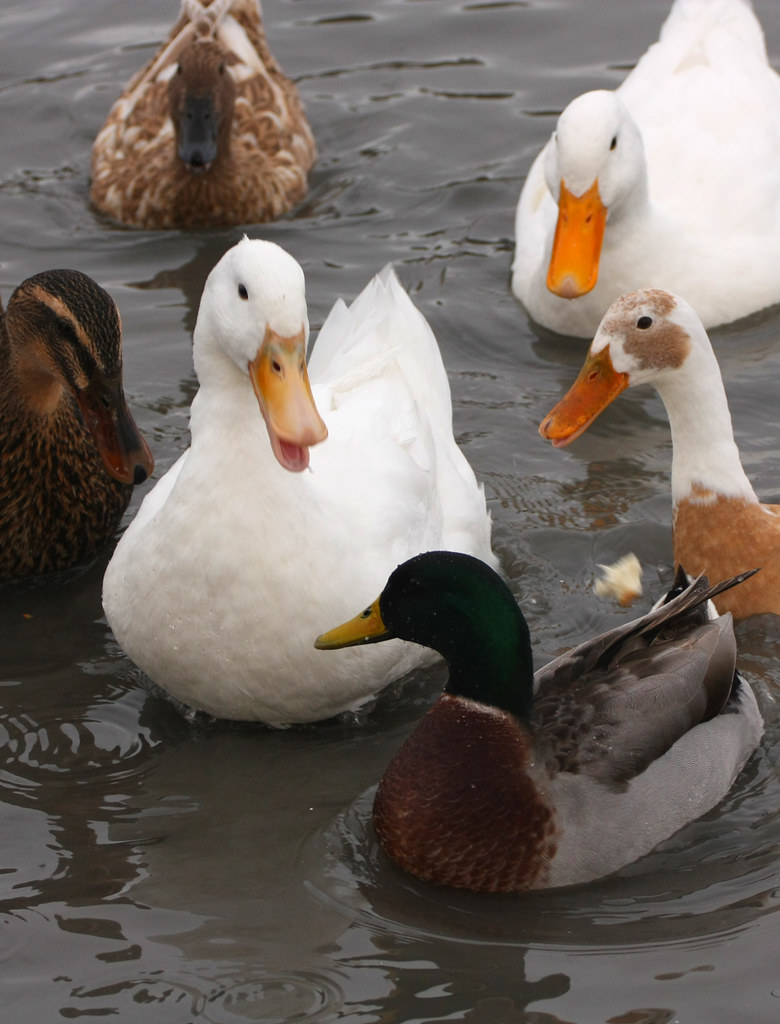
There were some people feeding the ducks that live at that pond, and they said it was fine if I came close enough to get pictures. I think I got a lot of good ones. Ducks are pretty friendly, not exactly camera shy; especially when there's someone with bread in the vicinity.

click to enlarge, or see it on Flickr
Aperture: f/6.3
Shutter Speed: 1/500
ISO: 400
Focal Length: 112 mm
Monopod
The white duck in the center was particularly fierce when it came to defending what he considered "his" bread. This photo looks like he's telling off that mallard for intruding on his space.
Let me tell you two contrasting stories—my (to date) two serious attempts at animal photography.
Once upon a time, I tried to take some pictures of my cat. He wandered all around everywhere, wouldn't hold still, and seemed to be purposefully ruining my lighting with every tiny movement.
Once upon a time, I was on my way to a little creek area near my house. I stopped at a neighbor's enclosure where they keep goats. The goats were the perfect subjects. They seemed genuinely interested in my photography efforts.

click to enlarge, or see it on Flickr
Although the photo turned out slightly overexposed near the top, the subject and lighting couldn't have been better. I shot with my white balance set to "cloudy," and my flash's dimmest setting to fill in the faces a bit. Lovely. Thank you, goats!